
150+ Years of Combined Experience. Hundreds of Millions Recovered.
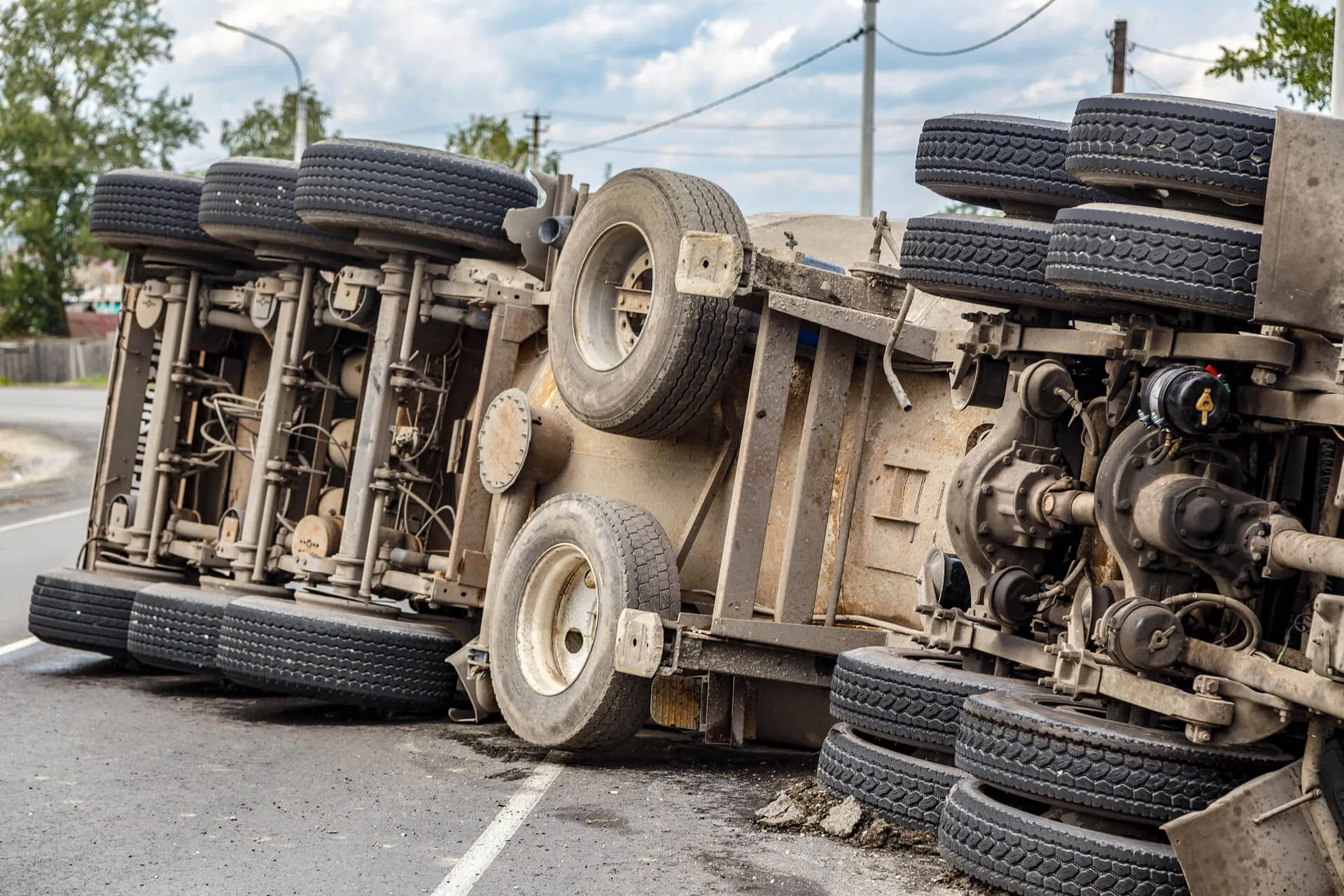
Tampa 18-Wheeler Accident Lawyer
After a crash with an 18-wheeler, a Tampa 18-wheeler accident lawyer can sort out whether the carrier, the trailer owner, or the shipper pays. Winters & Yonker has handled nothing but injury claims since 2001. We work to trace each company behind the truck and its coverage.
Get My Free Case Review
Free consultation, no obligations. If you would rather not type, (813) 223‑6200 is available 24/7.
Aggressive Tampa 18-Wheeler Accident Attorneys
Tampa 18-Wheeler Accident Claims and Who Owned Each Half
An 18-wheeler, or semi-truck, is not one vehicle. It is two, coupled together at a single pivot point, and they are frequently owned by two different companies carrying two different insurance policies.
A Tampa 18-wheeler accident lawyer can work to establish who owned which half and what coverage each carried. Winters & Yonker has represented injured people across Tampa Bay since 2001. Our attorneys bring more than 150 years of combined legal experience, and the firm has recovered hundreds of millions of dollars for injured clients. The consultation is free.
Federal rules cap a five-axle rig at 80,000 pounds on the Interstate system. That’s roughly 20 times the car beside it. All that weight takes longer to stop, and brakes that overheat on repeated hard stops need more room still.
The engine’s control module logs speed, throttle, and braking in the seconds before impact, and it keeps overwriting as the truck runs. Our in-house litigation team sends a preservation demand in the first weeks, before the rig is repaired and back in service.
How an 18-Wheeler Tractor and Trailer Pivot at the Fifth Wheel
The name describes the configuration. Two wheels on the steer axle at the front of the tractor, eight across the tractor’s two drive axles, and eight more across the trailer’s tandem axles. Eighteen in total.
What matters is not the count but the coupling. The tractor and the trailer are joined by a fifth wheel, a plate-and-pin arrangement that lets the trailer pivot behind the cab. That articulation is what allows a 53-foot trailer to turn a corner, and it is also what allows the trailer to swing out of line under hard braking or on a slick surface.
A passenger car is a single rigid body. An 18-wheeler is a hinge. Every handling characteristic that distinguishes one of these crashes from an ordinary collision follows from that hinge and from the weight behind it.
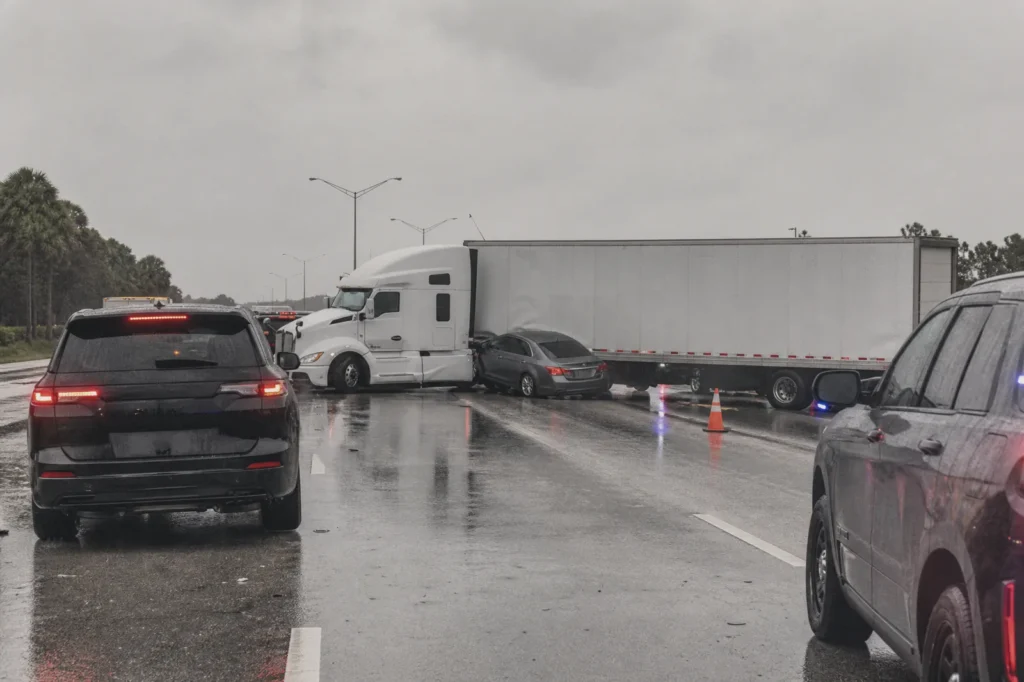
An 80,000 Pound 18-Wheeler Does Not Stop Like a Car
Federal law generally caps a five-axle combination at 80,000 pounds gross weight on the Interstate system, with tandem axle groups limited to 34,000 pounds. A loaded rig therefore weighs roughly twenty times what the car next to it weighs.
Truck Stopping Distance and Federal Brake Standards
Braking is where that shows. Under federal motor vehicle safety standard 121, most heavy truck tractors loaded to their gross weight rating must be able to stop within 250 feet from 60 miles per hour. Before that standard was tightened, the permitted distance was 355 feet. Those are the regulatory minimums under controlled testing conditions, not what happens on a wet afternoon on I-4.
Two things make the real number worse. Perception and reaction time run before any braking begins, and at 60 miles per hour a vehicle covers 88 feet every second the driver spends recognizing a hazard. And brake systems fade. Repeated hard stops on a long downgrade heat the drums past what they were designed to dissipate, and a rig that stopped within the required distance on its first application can need considerably more on its fifteenth.
The practical consequence for a claim is that a rear-end collision by an 18-wheeler is rarely just a following-distance problem. It is a question of what the driver could have stopped in, given what the truck weighed and how the brakes had been maintained.
Cargo Overloading, Distribution, and Securement in an 18-Wheeler Accident Case
An 18-wheeler carries the cargo that makes it dangerous, and how that cargo was loaded is often the most productive line of inquiry in the case.
Three problems recur.
- Overloading. A combination that exceeds its rated weight carries proportionally more energy into a collision and asks its brakes to absorb heat they were not sized for.
- Distribution. Weight concentrated high or unevenly raises the center of gravity, which lowers the speed at which the trailer will roll on a curve or an off-ramp.
- Securement. Freight that shifts in transit changes the handling of the trailer mid-maneuver, and freight that leaves the trailer becomes a hazard to everyone behind it.
Bills of Lading and Cargo Records
None of that is guesswork after the fact. A load has paperwork. The bill of lading states what the trailer was carrying and what it weighed, and weigh station records, scale tickets, and the shipper’s own loading documents can establish whether the rig was legal when it left.
Shipper Liability for Cargo Loading Errors
Where the cargo was loaded by a shipper or a third-party crew rather than by the driver, responsibility for how it was secured may not sit with the trucking company at all.
Case Results
Hundreds of Millions Recovered Since 2001
- $800,000Trucking case
- $500,000Trucking case
- $5,000,000Auto accident
Figures are shown before attorney fees, case costs, and medical liens. Past results do not guarantee or predict a similar outcome in any future case.
Who Owns the 18-Wheeler Trailer and Which Insurer Responds
This is the part most people do not expect. The tractor and the trailer are separate pieces of registered equipment and they are frequently owned separately.
An owner-operator may drive their own tractor while pulling a trailer belonging to the carrier that hired them. A carrier may pull a trailer belonging to a shipper, a leasing company, or another carrier under an interchange agreement. Each of those arrangements comes with its own insurance, and the policies do not always agree about which of them responds to a given crash.
That distinction decides real money. If the crash traces to the trailer, its brakes, its tires, its lighting, or its underride guard, the trailer’s owner and insurer may be in the case regardless of who was driving. Identifying both halves early is what allows a claim to reach beyond whichever policy happened to be easiest to find.
Underride Crashes and 18-Wheeler Accident Injuries in Tampa
A trailer bed sits higher than the bonnet of a passenger car. When a car strikes the side or rear of a trailer, or is struck by one, the car can travel underneath rather than stopping against it.
That is underride, and it is why these collisions produce the injuries they do. In an ordinary crash the front of the vehicle crumples and absorbs energy before the passenger compartment is reached. In an underride, the trailer bed passes over the bonnet and into the windscreen and roof line, and the survival space is gone.
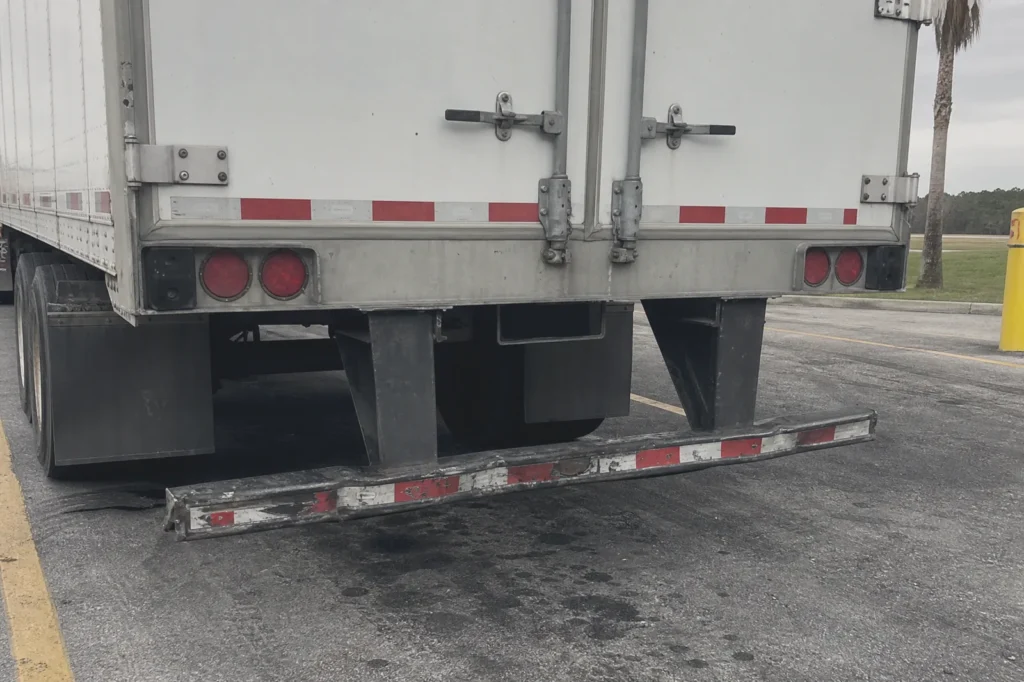
Rear Underride Guard Failures on Trailers
Rear underride guards are required equipment and they fail. They are struck off-center, they are corroded, they are damaged and not repaired, or they were never adequate for the closing speed. Side underride protection is not required at all on most trailers. Whether a guard was present, what condition it was in, and whether it performed as designed are all questions worth asking, and they are answered by inspecting the trailer rather than the tractor.
Electronic Control Module Data From an 18-Wheeler
A heavy truck engine carries an electronic control module that logs how the vehicle was operated. It is a different record from the driver’s duty logs, and it answers a different question.
Truck Engine Data and Driver Duty Logs
Where hours of service records show how long someone had been working, the control module shows what the truck was doing in the seconds before impact. Road speed. Throttle position. Whether the brakes were applied, and when. Whether a hard-braking event was recorded at all.
That data settles arguments that testimony cannot. A truck driver who says they braked, in a truck whose module shows no brake application, has a problem. The module holds a limited amount of data and continues overwriting as the truck keeps running, which is why the request has to go out before the rig returns to service.
Catastrophic Injuries and 18-Wheeler Claim Value
The value of an 18-wheeler claim is driven by the same factors as any injury claim, and it tends to sit higher for a reason that has nothing to do with the law. Collisions at these weights produce catastrophic outcomes more often, which means the medical care runs longer, the time away from work runs longer, and the question of whether someone returns to their old job is live rather than theoretical.
A claim may include:
- Medical treatment already received and the projected cost of future medical care
- Lost wages and income during recovery
- Reduced earning capacity where the injury prevents a return to the same work
- Rehabilitation, assistive equipment, and home modification
- Pain and suffering, mental anguish, emotional distress, and reduced quality of life
- Permanent scarring or disfigurement
Where someone does not survive, the claim becomes a wrongful death claim and follows a separate framework with its own rules about who may bring it.
18-Wheeler Evidence Leaves Before the Florida Injury Claim Deadline
Every deadline that applies to a Florida injury claim applies here, and the parent truck accident page covers them. What is specific to an 18-wheeler is how quickly the physical evidence stops being available.
A tractor and a trailer are working assets. Once released, they are repaired and put back into service, and the control module keeps recording over what it held. A damaged underride guard is replaced. A trailer moves to another carrier under a different agreement. Scale tickets and loading documents sit with businesses that have no obligation to keep them for your benefit.
Preservation Demands Sent in the First Weeks
A preservation demand sent in the first weeks is what interrupts that. Sent later, it arrives after the rig is back on the road.
Paying for an 18-Wheeler Accident Lawyer
The consultation is free, and there is no cost to find out where your claim stands.
Case costs and expenses are the costs of building a claim, such as filing fees, medical records, and expert witnesses. You pay no attorney fees and no case costs unless we recover money for you. How the attorney fee is calculated, how case costs are handled, and what you would owe in different outcomes are all set out in a written fee agreement that we go over with you before you decide.
Talk to Us Before the Rig Is Repaired
The carrier knows what its equipment is worth idle. It has every reason to inspect, repair, and redeploy quickly, and no reason to preserve anything for you.
Call us and tell us what happened. We will tell you where you stand. The consultation is free.
Related Claims We Handle
This page covers the tractor-trailer specifically. The parent page and its other sections cover the wider set of commercial vehicle claims.
-
Truck Accidents
The parent page, covering federal safety rules, driver records, and how liability is shared across a trucking operation.
Learn More : Truck Accidents -
Jackknife Accidents
What happens when the trailer swings out of line behind the cab, and what the braking data shows.
Learn More : Jackknife Accidents -
Car Accidents
The broader vehicle claim, including how Florida no-fault coverage works and what it does not pay for.
Learn More : Car Accidents -
Wrongful Death
Collisions at these weights are fatal more often, and that claim follows its own framework.
Learn More : Wrongful Death -
All Practice Areas
The full range of injury claims the firm handles, in one place.
Learn More : All Practice Areas
18-Wheeler Questions Clients Ask Most

Why does it matter who owned the trailer?
Because the tractor and the trailer are often owned by different companies with different insurance. If the crash traces to the trailer, its brakes, tires, lighting, or underride guard, the trailer’s owner and insurer may be responsible regardless of who was driving.
How far does a loaded 18-wheeler need to stop?
Federal safety standards require a heavy truck tractor loaded to its gross weight rating to stop within 250 feet from 60 miles per hour under test conditions. Real distances run longer, because reaction time comes first and brakes lose effectiveness as they heat up.
What is underride, and why does it cause such severe injuries?
A trailer bed sits higher than a car bonnet, so a car can travel underneath rather than stopping against it. The crumple zone never engages, and the trailer passes into the windscreen and roof line instead. Rear guards are required and can fail. Side protection is not required on most trailers.
Can the shipper be responsible for how the cargo was loaded?
Sometimes. Where a shipper or a third-party crew loaded and secured the freight rather than the driver, responsibility for a shifting or lost load may sit with them. The bill of lading, scale tickets, and loading documents are what establish it.
What does it cost to hire an 18-wheeler accident lawyer?
The consultation is free. You pay no attorney fees and no case costs unless we recover money for you. How the attorney fee is calculated, how case costs are handled, and what you would owe in different outcomes are all set out in a written fee agreement that we go over with you before you decide.
Our Offices and Service Areas
Our Tampa office is in Hyde Park at 601 W Swann Ave., and we handle Hillsborough County claims through the Thirteenth Judicial Circuit.
The firm also has locations in St. Petersburg, Clearwater, New Port Richey, and Lakeland. Tampa is our staffed office, and the other four are available by appointment.
- Tampa, FL 601 W Swann Ave, 33606
- St. Petersburg* 111 2nd Ave NE, Ste 350, 33701
- Clearwater* 1006 Drew St, 33755
- New Port Richey* 5006 Trouble Creek Rd #200, 34652
- Lakeland* 1543 Lakeland Hills Blvd, Ste 18, 33805
* Available by appointment. Tampa is our staffed office.
Get a Free Consultation
Or call now: (813) 223-6200
Client reviews
What your neighbors say.
★★★★★ 4.6 average on Google across 536 reviews of our Tampa, St. Petersburg, Clearwater, New Port Richey and Lakeland offices.
“I can’t say enough about this law firm as a whole. Patrick, Courtney, Taylor and Gracie Exceptional Professionalism! My accident case was handled with care and consideration. My first Attorney experience ever, and the communication and knowledge was all that!! If I ever need a law firm again, trust and believe I will be calling on Winters and Yonkers, I will ask for Attorney Patrick Brannon. Thank you, thank you!!”
“I am so please to have been referred to talk with Chris Smith when I got into an accident that was not my fault. Discovering that I had an injury, he helped me to get a new car and also my back injury recovered to its fullest potential, still won’t be the same but so grateful. Versus me not using him and not having annything available for my protection. Thank you Chris Smith. -Gina Brown”
“Would most definitely recommend Matt and Danica taking on your case. Hasn’t been a fun process, but they both walked me through the entire thing and made it less stressful overall. For sure would come back if I ever needed!!”
“Trevor and his team were awesome and handled everything from start to finish for me! The staff were nice and helpful also were quick in responding to any questions I may have had!”
“My experience with winters and yonker has been amazing they keep in the loop with no guessing if you need help ask for Chris if I ever need help again Im asking for him by name Thank u Chris”
“Trevor and his team were very kind and caring. Very professional and they did a great job helping me with my physical therapy, referrals doctors and my settlement. I appreciated their continued care and business. Thanks again!”
“Absolutely an amazing Law firm. They handled my case that happened to be a more difficult case but handled it with ease. They were professional and communicated very well every step of the way. Honestly they took the stress out of a stressful situation. Patrick, Tony and Tayler all went above and beyond! I highly recommend them to anyone in need.”
“Truly grateful for what my lawyer Trevor W.Colvin And his team did for me from day one. Make sure to get me the money that I deserve for an accident that was not my fault. Definitely recommend this law firm they truly do care about you.”
Reviews are from Google and are unpaid. Past results do not guarantee a similar outcome in your case.
