
Is It Legal to Run a Yellow Light in Florida?
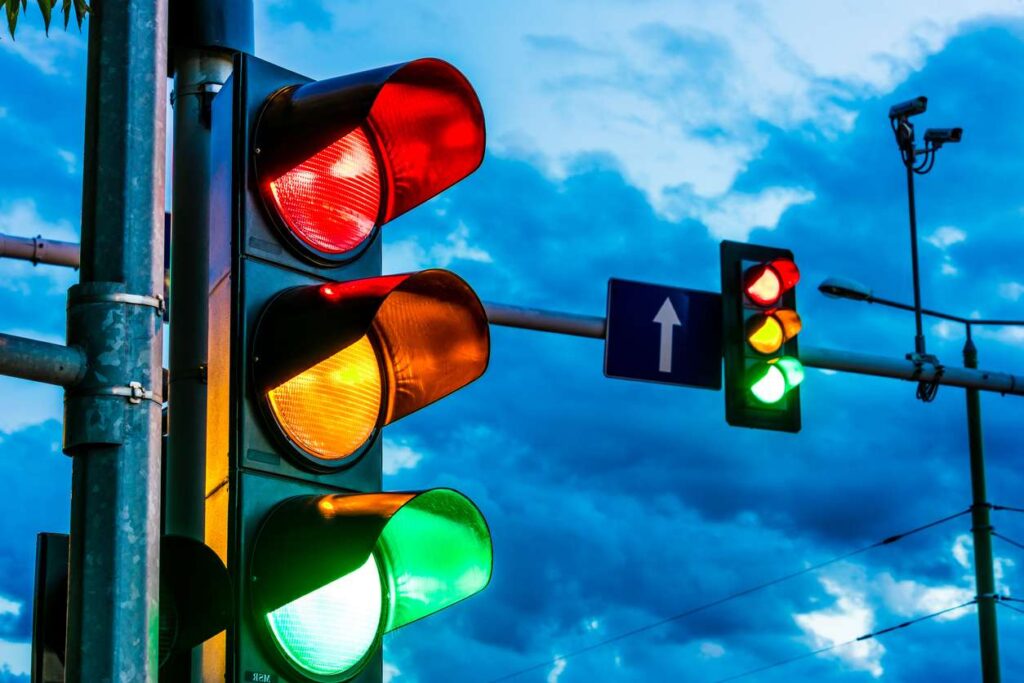
Entering an intersection on a steady yellow is not prohibited by Florida’s traffic signal statute. The prohibition on entering attaches to the red, not the yellow, although drivers still have to use reasonable care. That distinction gets blurred constantly, and it becomes a real problem after an intersection crash, when two drivers remember the same signal differently.
The Statute Puts the Prohibition on Red
Florida’s traffic control signal statute says what a steady yellow means, and it is worth reading closely. Vehicular traffic facing a steady yellow signal is warned that the related green movement is ending, or that a red indication will be shown immediately afterward, when vehicular traffic shall not enter the intersection.
Follow the clause. The warning is the yellow. The prohibition is the red. Nothing in that sentence makes entering on yellow unlawful.
What the statute does prohibit is entering on red without complying with its stopping requirements and permitted turn exceptions. Vehicular traffic facing a steady red signal has to stop before the crosswalk on the near side, or before the intersection if there is no crosswalk, and stay there until green shows, unless a permitted turn on red applies. There are exceptions for right turns and for certain one-way left turns, each with its own conditions.
So under the signal statute, yes, entering on yellow is permitted. That does not settle whether the driver acted carefully, or who may be responsible if a collision follows.
The Handbook Asks More of You Than the Statute
The Official Florida Driver License Handbook takes a firmer line. Under Yellow Light it says: warning, the light is changing to red. Stop if you can safely do so. It is extremely dangerous to be in an intersection when the light turns red.
That guidance does not create a separate yellow-light stopping requirement under section 316.075. Drivers still have to use reasonable care. The handbook is the state’s instruction manual for drivers rather than a statute, and the two say different things. The law describes what is prohibited. The handbook describes what a careful driver does.
It also gives guidance for the approach itself: approach at a speed that will allow you to stop if the light changes. That one is easy to skip past and it is the whole point. The speed of the approach affects how much room a driver has to respond when the yellow appears.
Deciding on Approach
Five situations cover most of what happens at a changing signal. The left column is what you are facing. The right is what the law provides, with the handbook’s guidance noted where it differs.
| What you are facing | What applies |
|---|---|
| The light turns yellow and you can stop safely before the stop line | Entering is not prohibited. The handbook advises stopping if you can safely do so. |
| The light turns yellow and you are too close to stop without braking hard | Entering on yellow is lawful. The statute places no stopping distance condition on it. |
| You are already inside the intersection when it turns red | The prohibition is on entering. The handbook warns that being in an intersection when the light turns red is extremely dangerous. |
| A steady yellow arrow shows for your turn | The green arrow is ending or the light is about to turn red. The handbook’s general yellow-light guidance is to stop if you can safely do so. The warning applies to the movement shown by the arrow. |
| A flashing yellow arrow shows for a left turn | You may turn in the direction of the arrow. The handbook states that you must yield to oncoming traffic, which has a green light, and to pedestrians. |
Notice what the table does not say. It does not tell you who is at fault if a crash follows. That is a separate question with a separate answer, and the signal is only one input to it.
Turns Carry Their Own Duty
A turn adds a second obligation on top of the signal, and that obligation matters when a collision happens.
The handbook is explicit about the flashing yellow arrow. Oncoming traffic has a green light. You may proceed with your turn, but you must yield to oncoming traffic and pedestrians. The arrow allows the turn. It does not give you priority over traffic or pedestrians you must yield to.
The same logic runs through a green light with no arrow. Traffic turning right or left yields to vehicles and pedestrians already lawfully in the intersection or an adjacent crosswalk. A signal that lets you move does not clear the path in front of you, which is why a left turn across oncoming traffic produces the collisions it does.
Pedestrians sit inside this too. A pedestrian facing a steady yellow is advised there is insufficient time to cross, and the statute says no pedestrian shall start crossing unless a pedestrian control signal directs otherwise. That tells you something useful as a driver: someone stepping off the curb on a late yellow may still be in your path, regardless of whether they were permitted to start crossing.
Cameras Enforce Red, Not Yellow
Florida permits camera enforcement at signalized intersections under the Mark Wandall Traffic Safety Program. The department, counties, and municipalities may use traffic infraction detectors, and what those detectors enforce is the steady red indication. Entering on yellow is not a red light violation, so that alone does not provide grounds for a citation under the camera enforcement program.
Two provisions are worth knowing. A notice of violation or a citation may not be issued for failing to stop at a red light where the driver is making a right turn in a careful and prudent manner at an intersection where right turns are permitted. The same restriction applies when a driver comes to a complete stop after crossing the stop line but before making a permitted right turn, even though the driver failed to stop at the required point.
The yellow interval itself is not left to chance at camera-enforced approaches. FDOT’s specifications for detector placement require the yellow change interval to be calculated using the Institute of Transportation Engineers formula and rounded up to the nearest tenth of a second. The interval must be at least 3.4 seconds and cannot exceed 6 seconds. FDOT’s specification also includes a table by posted speed, with adjustments for roadway grade. A red clearance interval is also required. So while section 316.075 does not fix a single yellow duration, FDOT provides timing requirements for approaches where cameras operate.
The Signal Is Not the Whole Question
After a collision the argument is rarely about what yellow means. It is about which signal each driver was facing and when, and those are factual questions answered with evidence rather than with the statute.
Things worth noting while they are fresh:
- Which signal each vehicle was facing, and whether either driver had an arrow
- Whether either vehicle had already entered the intersection when the signal changed
- Where the stop line and crosswalk sit on each approach
- Whether camera enforcement signage is posted at that intersection
- Whether anyone else saw the change, including drivers stopped on the cross street
- What the crash report records about the signal phase and about any citation
None of that decides fault on its own. Fault turns on whether a driver failed to use reasonable care and whether that failure caused the collision, and more than one driver can share it. What a crash claim involves runs well beyond the color of a light.
The Short Answer
Entering on a steady yellow is lawful in Florida. Entering on red is not, apart from permitted turns on red after a full stop. The handbook asks you to stop when you safely can, and that is advice worth taking, but the signal statute does not make yellow itself a prohibition on entering. Drivers still have to use reasonable care.
Where this stops being academic is in the seconds after a collision, when two accounts of the same signal start to diverge. If you were hurt in a crash at an intersection and the signal is in dispute, it is worth finding out what evidence exists before anyone settles the question for you.
Frequently Asked Questions
Is entering on a yellow light illegal in Florida?
No. The statute warns that a steady yellow means red is coming and prohibits entering once red is shown. It does not prohibit entering on yellow. The state driver handbook separately advises stopping if you can do so safely, which does not create a separate stopping requirement under section 316.075. Drivers still have to use reasonable care.
Can a red light camera ticket me for a yellow?
No. Entering an intersection while the light is still yellow does not, by itself, constitute a red light violation under the Mark Wandall Traffic Safety Program. The program enforces specified traffic signal violations involving red lights. It also restricts notices and citations for certain permitted right turns made in a careful and prudent manner.
How long does a yellow light last in Florida?
Florida Statute 316.075 does not set a single yellow light duration. Under FDOT’s published specifications for approaches monitored by traffic infraction detectors, the yellow change interval is calculated by formula, with a minimum of 3.4 seconds and a maximum of 6 seconds. The required timing depends on factors including the posted speed limit and roadway grade. A red clearance interval is also required.
Who is at fault if a yellow light crash happens?
The signal is one factor rather than the answer. Fault turns on whether a driver failed to use reasonable care and whether that failure caused the collision, and Florida allows fault to be shared between drivers. Under Florida’s comparative fault statute, an injured person found more than 50 percent at fault for their own harm cannot recover damages. Which signal each driver faced, and when, is established with evidence rather than assumed from the color.
Hurt in an intersection crash in Pasco County? Talk with a New Port Richey car accident lawyer about the evidence.
For more information, please contact Winters & Yonker Personal Injury Lawyers to schedule a free consultation with a personal injury lawyer in New Port Richey today. We have five convenient locations in Florida, including Tampa, Clearwater, St. Petersburg, New Port Richey, and Lakeland.
We proudly serve Hillsborough County, Pinellas County, Pasco County, Polk County, and its surrounding areas:
Winters & Yonker Personal Injury Lawyers – Tampa Office
601 W Swann Ave, Tampa, FL 33606
(813) 223-6200
Winters & Yonker Personal Injury Lawyers – Clearwater Office
1006 Drew St, Clearwater, FL 33755
(727) 605-7569
Winters & Yonker Personal Injury Lawyers – St. Petersburg Office
111 2nd Ave NE Suite 350, St. Petersburg, FL 33701
(727) 314-5988
Winters & Yonker Personal Injury Lawyers – New Port Richey Office
5006 Trouble Creek Rd Unit #200, New Port Richey, FL 34652
(727) 910-5060
Winters & Yonker Personal Injury Lawyers – Lakeland Office
1543 Lakeland Hills Blvd Suite 18, Lakeland, FL 33805
(863) 251-6196
Talk to Us Before You Talk to the Insurer
Adjusters negotiate claims every working day. Most people do it once in their lives, at the worst possible moment, while taking painkillers and missing work.
Call us and tell us what happened. We will tell you where you stand. The consultation is free.
